Showing posts with label dog dogs. Show all posts

Thursday, October 13, 2011

The Gift of Life


Just like humans, dogs can become blood donors.

Veterinarians can give a blood transfusion to dogs to improve their health or to save their lives.

If you have been looking for a way to help the canine community, enrolling your dog in a blood donation program is one way.

What canine blood donations entails:

Blood donor candidates need a physical exam, blood work, and screening for several conditions. Blood type is also tested, to screen for potential incompatibility. Once your dog enters a blood donor program, these tests are often performed twice yearly, and typically at no cost to you.

Blood banks have specific requirements for a dog to donate. Once dogs qualify, they are enrolled in the donation program. When they come in, they receive a physical exam and a blood test to check their red blood cell count. The actual blood donation only takes a few minutes. Then comes the reward.......food and treats! A dog can typically donated every two months, although this can vary with a dog's specific blood type and breed.

Enrolling in a canine blood donation program is a win-win situation. You and your dog receive some nice benefits, plus the satisfaction of knowing your dog will help save many lives over the years. One single donation can typically save the lives of four dogs!

Ask your veterinarian for information about the closest blood donation program.

Thursday, July 28, 2011

Ways to Beat Doggie Boredom


Many people wonder if their dogs can get bored and the answer is YES, they can. Imagine if you were locked alone in a house all day with nothing to do! Boredom is very real and it is a very big problem for dogs today.

Here are five ways to defeat boredom-for good.

1. New Tricks - One of the best ways to show love and spend quality time with your dogs is to teach them new tricks. It will take some time and practice, but it will provide great mental stimulation and help keep your dog engaged.

2. Physical Exercise - Running and playing with your dog is another great way to fight boredom. Fetch, wrestling, or racing are simple ways to tire out your dogs before you leave so they will take a long nap when you go instead of pacing around an empty house.

3. Puzzle Games - You can find lots of puzzle games that will keep your dog entertained. But, if you want to save some money, you can simply put some food or treats into a box that your dog must open to eat.

4. Socialization - Meeting new dogs and new people is quite an interesting experience for your dog. Boredom is easily defeated when your dog is making a new friend: canine, human, or otherwise.

5. New Toys - New toys are a great way to keep your dog entertained.

Thursday, April 28, 2011

Dog Etiquette


Wherever you go with your dog, remember you are a doggie ambassador. How you act with your dog not only affects others around you, but also how people think of dogs and dog owners in general.

Put your best foot and paw forward with dog etiquette:

1. Always clean up after your dog and abide by licensing and
leash laws.

2. Make sure your pet is a welcome guest. Call ahead to discuss
pet policies.

3. When visiting family and friends, if your dog ruins something in their home, offer to pay the repair fee or cleaning charge.

4. Only bring well-behaved, quiet dogs to outdoor restaurants. Dogs should be out of the way, such as lying underneath the table, so the wait staff and others can easily walk past.

5. When a repairman or other service provider makes a house call, crate your dog or put her in a room and shut the door. Some people are afraid of dogs or allergic to them.

6. Be a considerate neighbor by curtailing barking. Even hardened dog lovers are annoyed by constant yipping and yowling.

7. Do not allow your dog to roam freely. It is dangerous for you pet, plus it is disrespectful of other people who might be walking in your neighborhood.

8. Always ask permission before allowing your dog to greet another dog.

Being a doggie ambassador consists of combining dog training skills with common sense and basic good manners. Pet etiquette is practicing good behavior at both ends of the leash.

Tuesday, April 5, 2011

Do Not Let Your Dog Kiss A Toad


Do you know the difference between a frog and a toad?

The word "frog" is a general term. Toad is more specific. All toads are frogs but not all frogs are toads. For example, the Colorado River toad is a frog, and the green tree frog is not a toad. If this is still a little confusing, think of this. Your cuddly kitten may have very little in common with the lion, the King of the African jungle, but they both belong to the "cat" family.

However, in addition to their name and position on a species chart, frogs and toads can be differentiated by other means.

Toads have a special organ that other frogs do not. The Bidder's organ is a vestigial ovary that is found in the male toad. Another difference is that toads do not have teeth. This is an uncommon finding in species referred to as frogs.

In addition to body differences, toads differ from other frogs in their movement and life style. Toads really cannot jump like other frogs. They typically hop or crawl. Also, toads prefer to live their lives on the ground instead of in the trees, as many other frogs do. Despite their desire to be on firm soil, toads are quite adapt at climbing.

The reason I bring this up is that the venom secreted through the skin of some toads is highly toxic to pets. Dogs, which are the most likely pet to come into contact with a toad, have a high probability of dying if untreated. The Colorado River toad and the giant toad (also called the marine toad) are the two most common venomous toads found in the United States.

The Colorado River toad can be found along large streams in the southwestern United States, from Arizona to southern California (and Mexico). Its brown/green skin is usually covered with warts. They grow to be about three to seven inches long. The giant toad is not as common, but can be found in south Texas and Florida. This brown toad grows to be four to six inches long. It is very toxic to pets.

Because dogs are more curious and extroverted, they tend to be treated for toad poisoning more often. But a dog does not necessarily have to lick or eat a toad to be poisoned. There have been cases where frogs have been attracted to a dog's water dish and sat along the rim. Enough toxin can be left to make a dog sick.

Monday, March 21, 2011

Do I Have Your Attention?


Dogs engage in a little attention getting behavior from time to time, and there is nothing particularly wrong with that – as long as the behavior stays within reasonable limits.

But what you have to remember is that your dog will quickly learn what works and what does not according to how you respond. If you always (or even worse, sometimes) cave in to unreasonable requests, you will get even more of the obnoxious behavior in the future. The principle involved is "positive reinforcement," which effectively ensures that you reap what you sow. Even telling your dog to stop, or reprimanding him, can be rewarding for some dogs. The principle here is that some attention, even negative attention, is better than no attention at all.

Does this sound familiar to raising children? Yes, it is!

Attention seeking behavior can reach serious proportions. Take, for example, a dog that is always barking in your face to maintain your undivided attention, or one that constantly jumps on you or paws you whenever you are talking with a friend. Some dogs try to attract attention by stealing things and chewing them up or even swallowing them. Your hysterical reaction, yelling and chasing the dog to get the object back, can be just what the attention-needy dog wants. The game "keep away" that results is, apparently, a whole lot of fun for the dog – especially if you wave your arms around and scream a lot.

What to Do About It

The main principle behind treating attention-seeking behaviors is to ignore the behavior. But it does not work right away. In fact, the behavior may get worse, even more intense or more demanding, before it eventually fades away. It is as if the dog is thinking, "That's odd – this used to work. I had better try even harder to make it work again."

It might go like this:

1. Owner ignores unwanted behavior, say, stealing objects.

2. Dogs steals more items, more often and dances around in front of the owner to try to get him to intervene or chase him.

3. Owner continues to ignore the behavior.

4. Dog starts to lose confidence in this attention-getting technique and performs it less frequently.

5. Owner continues to ignore the dog's charades.

6. Dogs attention seeking behavior eventually peters out.

WARNING

If you give in intermittently, or succumb to your dog's charades after a lengthy period of trying to "tough it out," you will actually reinforce the behavior even more firmly. The dog learns that if he keeps it up, attention will eventually come his way.

How to Hasten Successful Treatment

Use of a "bridging stimulus" can help speed up successful treatment. A bridging stimulus is a neutral signal or cue that heralds a particular consequence. The actual stimulus could be the sound of a duck call or clap, or click. The noisemaker is sounded at the time the dog is engaging in the unwanted behavior to signal that the owner is about to withdraw attention, perhaps even leave the room. You must follow through after issuing the cue. It must always signal immediate withdrawal of your attention or the dog will fail to make an association between its unwanted behavior and the inevitable consequence.

What the bridging stimulus does is focus the dog's attention on that point in time when attention withdrawal is imminent. It is not intended to be aversive but rather to be a consistent herald of what is to follow. Attention behavior will melt away more consistently and rapidly if a bridging stimulus is used than if attention withdrawal is employed on its own without such a signal.

Philosophical Considerations

If a dog is always begging for attention there must be a reason. It may be that the dog is being ignored at home or that he is spending too much time alone or in a crate. It may be that the dog is getting insufficient exercise or mental stimulation and has excess steam to blow off or has nothing better to do. It is important to address these issues, too, rather than just trying to stop the dog from doing something that annoys you. Attention-seeking behavior may be merely the tip of an iceberg of discontent.

Conclusion

Dogs that display attention-seeking behaviors are needy individuals that are probably under duress or are in some emotional conflict. Pretty much, any behavior can be reinforced as an attention seeking behavior: Attention-seeking components may be involved in various other behavior problems, too. The attention-hungry dog will do whatever works best to get you to pay more attention to him.

Thursday, March 17, 2011

Full Moon Activity

Do full moons influence animal behavior,
or is that just a fanciful myth?

According to the latest research, pets get into more mischief and are injured more often during certain phases of the lunar cycle, particularly when the moon is fullest.

The study, authored by Raegan Wells, DVM, and her colleagues at Colorado State University's College of Veterinary Medicine and Biomedical Sciences, revealed a link between an increase in emergency room visits for dogs and cats during days when the moon is at or near its fullest.

Wells said this is the first time the lunar cycle's relationship to emergency veterinary medicine has been studied. The study, titled "Canine and feline emergency room visits and the lunar cycle,” appears in the Journal of the American Veterinary Medical Association.

The data, compiled from case histories of 11,940 dogs and cats treated at the university's Veterinary Medical Center, indicates that the risk of emergencies on fuller moon days was 23 percent greater in cats and 28 percent greater in dogs when compared with other days.

"If you talk to any person, from kennel help, nurse, front-desk person to doctor, you frequently hear the comment on a busy night, 'Gee is it a full moon?'" said Wells. "There is the belief that things are busier on full-moon nights."

Of course, superstition alone does not make for good science, but this research indicates that long held belief may be based in fact. But despite the baffling results, Wells doesn't know what sort of connection is at play here.

But just what is behind the pet emergency and full moon correlation, however, is not at all clear. One theory is that since there’s more light out, people and their pets may be more likely to be out getting into mischief. So, what does all this mean for pet owners?

Biggest FULL MOON in almost 20 years!

On March 19th, a full Moon of rare size and beauty will rise in the east at sunset. It's a super "perigee moon."

Where will your dog be?


Friday, December 24, 2010

Dog Family Christmas

Most of you are gathered together with your families this Christmas Eve.

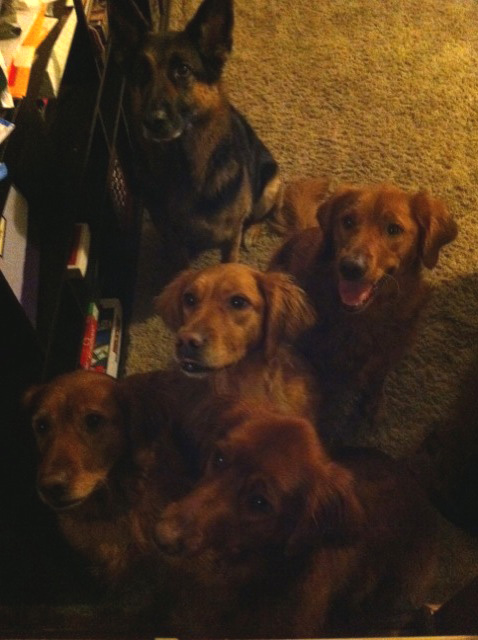
In my son's household that family gathering includes the dogs. Can you imagine a house full of Golden Retrievers? Cute, but I imagine chaotic!


Oh, did I forget to mention Koda, the German Shepard, as part of the family clan?


How can Ebony miss out on all this fun?! Besides, a black dog would add variety.

Maybe I should bring her when I visit on Christmas Day :)

Monday, March 8, 2010

Puppies Grow Fast

Puppies do grow and develop quickly. Have you ever seen a puppy grow in only a couple of minutes?

A dog basically goes from a baby to an adult in one year's time - which is equivalent to almost 18 years of human life. After that, their growth slows down, but the first 6 months are amazing.

I found this very sweet video. This owner took a photo of their dog every day from the time he was 6 weeks old until he turned 6 months old, and turned it into a 2-minute video! It is very cute!

Check out how quickly this pup grows!

Sunday, January 24, 2010

What About Pets in Haiti?


I have read about the many relief efforts in Haiti, but they are mostly focused on human needs and issues, which are considerable. However, I could not help but think about the poor pets.

It appears that there are several U.S and international groups that are banding together to help the animals, but it may be a few weeks before aid workers are sent.

According to the ASPCA (American Society for the Prevention of Cruelty to Animals®) website, they have joined the Animal Relief Coalition for Haiti (ARCH). ARCH is a coalition created to address the needs of animals in Haiti following the country's devastating earthquake.

The ASPCA pledged an initial $25,000 to support ARCH's relief efforts.

The ASPCA indicated that they plan to extend their full support to Haiti's animal victims by joining forces and collaborating with other organizations. USA Today indicated that a team of animal responders is awaiting access to Haiti to begin animal relief with medications, food, bandages, and other supplies. There are millions of goats, livestock, stray dogs and other animals affected.

So relief is coming for the animals. We hope that it comes in time.